An industrial arm may know the 6D pose of a component and still not know how to pick it up. A parallel-jaw gripper needs two reachable surface contacts, enough opening to span them, and a closing direction that holds the object instead of pushing it away. Antipodal grasp sampling turns object geometry into candidate answers.
Object mesh
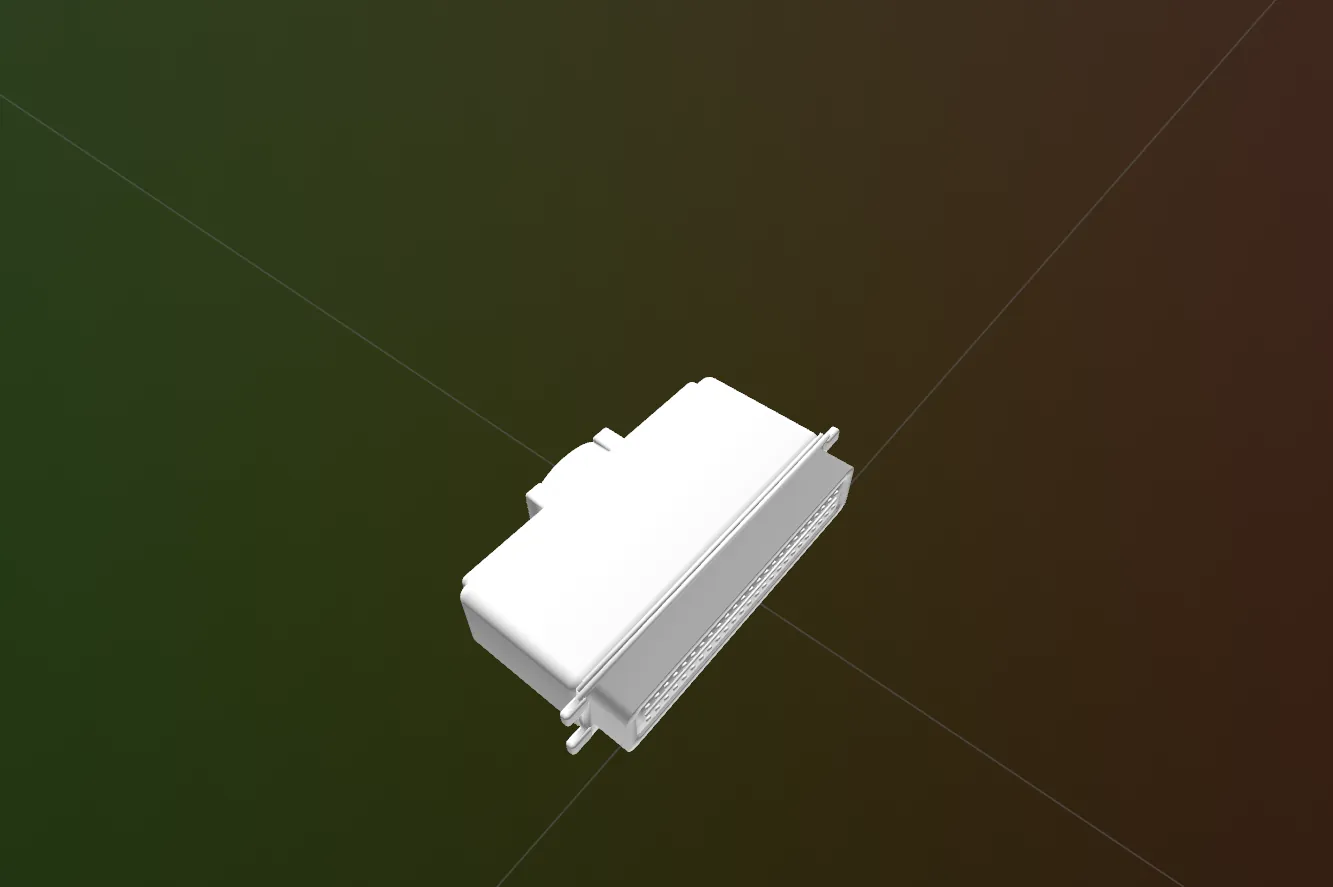
Grasp candidates
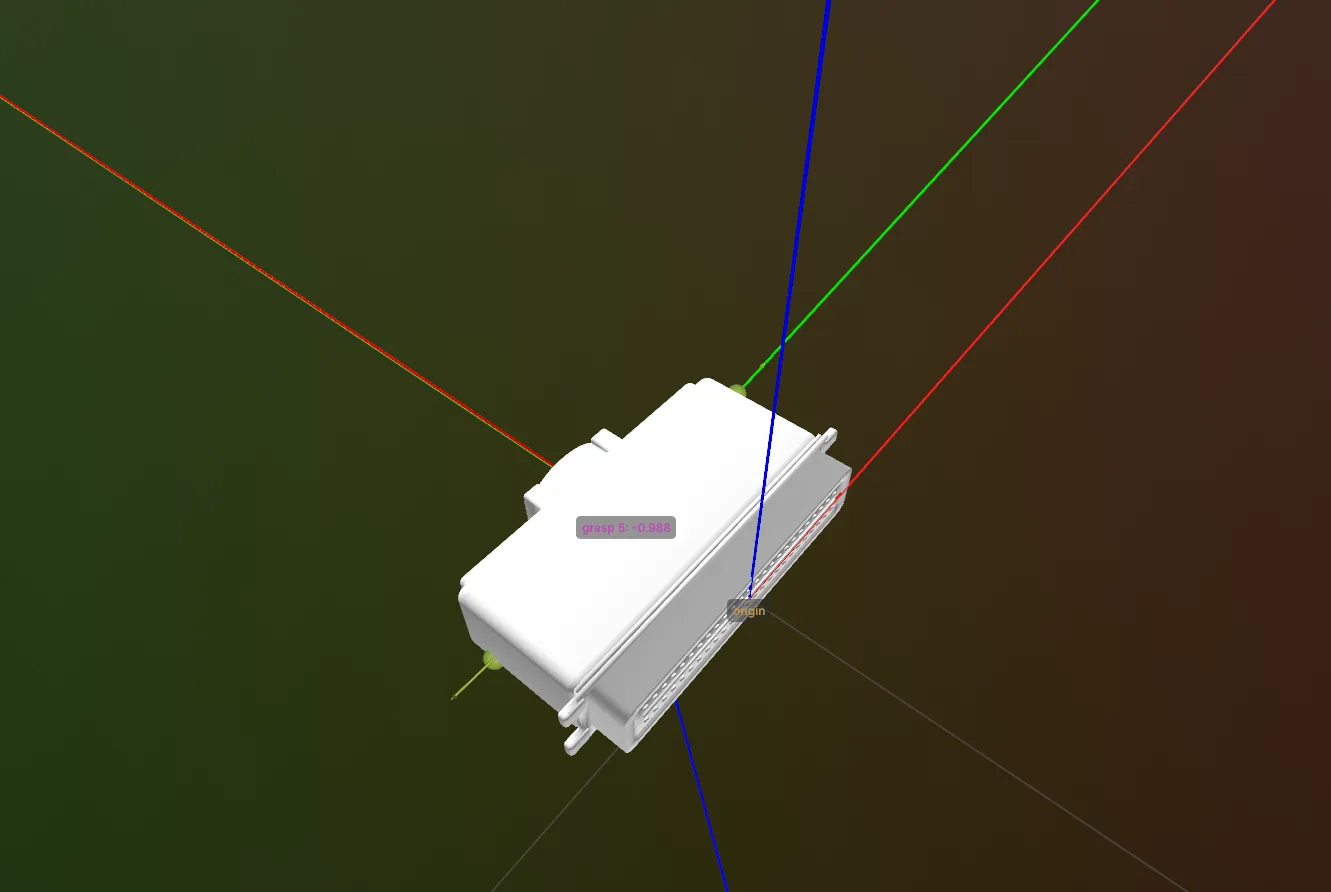
1. What is Antipodal Grasp Sampling?
Antipodal grasp sampling searches an object’s surface for pairs of opposing contacts that a parallel-jaw gripper could close around. This tutorial follows the mechanism from mesh triangles and surface normals to contact tests, grasp coordinate frames, scores, and the safety checks still required before motion.
The everyday intuition is pinching an object between a thumb and finger. Contacts on opposite sides are useful when their surface normals face roughly against one another and the fingers can apply inward forces along a common closing direction. The geometry is called antipodal because the contacts oppose each other.
The output is not “the grasp.” It is a set of candidates. Surface geometry cannot by itself prove that the arm can reach the pose, the fingers avoid collision, friction is sufficient, the object’s mass is supported, or the approach path is clear.
1.1 The Complete Sampling Pipeline
Object surface → parallel-jaw grasp candidates
Antipodal contact is a useful geometric candidate test, not a complete motion plan or guarantee of force closure under real friction.
The pipeline begins with a triangle mesh and the object’s pose in the world. The mesh supplies surface positions and normals; the pose tells the sampler where that surface currently sits relative to the robot.
The sampler proposes two surface contacts. It first checks whether their separation falls between the gripper’s minimum and maximum opening. It then checks whether their normals are sufficiently opposed. Pairs that fail either test are rejected, and sampling continues until enough grasps are found or the retry budget is exhausted.
For each accepted pair, the midpoint becomes the grasp origin and the contact-to-contact line defines the closing axis. The sampler returns this frame as a world-coordinate transformation, along with a geometric score and the underlying contact points and normals. Downstream planning must turn those geometric proposals into executable robot motions.
1.2 What a Surface Normal Tells the Gripper
A triangle mesh approximates a surface with connected planar faces. Each face has a unit normal, a vector perpendicular to that face. At a sampled contact , write its outward unit normal as , where
is Euclidean length. The normal describes local surface orientation, not the direction a finger must travel through free space.
For two contacts, the dot product
measures their opposition. is the antipodal score, while and are the two outward normals. Because both are unit vectors, lies between and . A value near means the normals face in opposite directions; zero means they are perpendicular; and means they point the same way.
In the Telekinesis Skill, antipodal_thresh is the maximum accepted dot product. With the default -0.95, a pair must satisfy roughly
Making the threshold more negative demands stronger opposition and usually produces fewer candidates.
1.3 Contact Separation Must Fit the Hardware
Let the contact distance be
and are contact positions and is their Euclidean separation. A pair is considered only when
where and are the minimum and maximum contact distances. max_pt_dist should reflect the gripper’s usable maximum opening, including finger thickness and safety margin. min_pt_dist avoids degenerate pairs that are too close to define a stable grasp.
The mesh must use metres for this Skill. A model exported in millimetres without conversion makes a 40 mm gripper appear unable to span even a tiny feature.
Interactive grasp test
Change the jaw opening and normal requirement to accept or reject contacts
1.4 Antipodal Geometry and Friction
Perfectly opposite normals are a clean geometric proxy, but real grasp stability depends on friction. At each contact, Coulomb friction allows a resultant force inside a friction cone around the inward normal. Its half-angle satisfies
where is the coefficient of friction and is the cone half-angle. Larger friction permits a wider set of force directions.
For an ideal two-finger antipodal grasp, the line joining the contacts should lie inside both friction cones when directions are interpreted inward at each surface. Opposing normals make that condition more plausible, but a normal-dot-product threshold alone does not explicitly model material friction, contact patch deformation, or force limits.
This distinction matters for polished metal, flexible packaging, oily parts, or soft fingertips. A candidate that is geometrically antipodal can still slip in execution.
1.5 How a Contact Pair Becomes a 6D Grasp Pose
The contact midpoint is
becomes the origin of the candidate grasp frame. The Telekinesis output uses the frame’s positive Y axis as the gripper closing axis. A normalized direction between contacts can therefore define
is the unit closing direction. The positive Z axis points the gripper toward the object and serves as an approach direction. Once two perpendicular axes are established, the third follows from a cross product, producing an orthonormal rotation matrix .
The complete world-frame grasp transform is
expresses grasp frame in world frame , and is the midpoint expressed in world coordinates. This frame convention must be converted to the robot’s actual tool-center-point convention before planning.
1.6 The Object Pose Connects Mesh and World
The mesh is usually stored in an object-local frame. X_WO gives the pose of object frame in world frame . For a local mesh contact ,
is the world-frame contact and is an invertible rigid transform. If this pose is stale or has the direction reversed, every returned grasp is misplaced even when contact sampling is internally correct.
Pose uncertainty should influence clearance. A grasp that barely avoids a neighboring fixture in the nominal pose may collide when the object estimate is off by a few millimetres.
1.7 Sampling, Scores, and Retry Budget
The algorithm samples rather than enumerating every pair of surface positions, because the pair space grows quickly. num_grasps requests a target number of accepted candidates, while max_sample_retries limits how long the sampler searches.
The function can return fewer grasps than requested. This is meaningful: the geometry, thresholds, opening limits, or retry budget did not yield enough candidates. Robot logic must handle zero candidates without assuming a service failure.
The returned score is based on the normal dot product, so more negative values mean stronger normal opposition. It is not a complete probability of grasp success. Two candidates with equally opposed normals can have very different approach clearance, torque resistance, reachability, and robustness to pose error.
Use a deterministic seed during testing so parameter changes can be compared against the same random sequence. Use multiple seeds during evaluation to measure how stable the sampler is rather than overfitting one sequence.
1.8 From Candidate to Executable Grasp
Before commanding an arm or humanoid hand, each candidate should pass several more stages:
- Transform the sampler frame into the gripper TCP convention.
- Offset along the approach axis to create a pre-grasp pose.
- Check inverse kinematics and joint limits for pre-grasp and grasp.
- Check gripper, wrist, arm, object, and environment collisions along the approach.
- Verify finger placement on the actual observed surface, not only the nominal mesh.
- Rank by clearance, reachability, pose uncertainty, force/torque robustness, and task intent.
- Execute with force, position, or contact monitoring and a safe recovery path.
Antipodal sampling proposes where a parallel jaw could pinch. Motion planning determines whether the robot can get there safely, and grasp execution determines whether the physical interaction succeeds.
1.9 Important Limitations
The sampler assumes a usable triangle mesh. Holes, incorrect normals, non-manifold surfaces, or a mesh that differs from the real part can create invalid contacts. Thin shells can also produce pairs on faces that do not represent graspable material thickness.
Parallel-jaw antipodal geometry does not directly describe suction, multi-finger hands, enveloping grasps, or grasps chosen for a later assembly motion. It also does not model center of mass. Pinching one end of a long tool may produce strong local opposition but poor torque balance.
Finally, it does not include scene collisions by itself. A contact pair can be valid on the object while the gripper body passes through the bin wall.
1.10 A Worked Connector-Grasp Example
Consider a connector body that is 42 mm wide, positioned by FoundationPose, and handled by a parallel-jaw gripper whose reliable opening range is 8–70 mm. The engineer sets min_pt_dist=0.008 and max_pt_dist=0.070 metres. A strict normal threshold of -0.97 initially finds only two grasps, both near an obstructed end of the connector.
Relaxing the threshold to -0.93 produces more candidates along slightly tapered side faces. This does not mean the relaxed set is better. Each candidate is transformed into the gripper TCP frame, expanded into a pre-grasp approach, and checked against the tote and neighboring components. After collision and inverse-kinematics checks, four candidates remain.
Those candidates are then perturbed using the measured pose uncertainty. A grasp that collides after a 3 mm lateral shift is ranked below one with wider clearance, even if its normal-dot-product score is more negative. The final choice balances contact quality with execution robustness.
The example reveals why geometric score should not become the only sort key. The best normal alignment may belong to a pose the robot cannot approach, while a slightly less antipodal pair may produce a much safer pickup.
1.11 Candidate Diversity Matters
Random sampling can produce many near-duplicate poses on a large flat face. Twenty almost identical grasps do not give a planner twenty useful alternatives. A production pipeline can group candidates by position and orientation, then retain the best representative from each neighborhood.
Diversity helps when the scene changes. One approach direction may be blocked by a tote wall, another may place the wrist near a singularity, and a third may conflict with the next assembly motion. Keeping candidates from different object sides and approach directions lets later planning use information the surface sampler does not have.
When comparing seeds or parameter settings, report both candidate count and coverage over distinct grasp regions. Otherwise, a configuration that generates many duplicates can look better than one that finds fewer but more useful options.
2. Using Antipodal Grasp Sampling in the Telekinesis Agentic OS
Telekinesis exposes generate_grasps_using_antipodal_sampler through Vitreous:
import numpy as np

from telekinesis import datatypes, vitreous

mesh = datatypes.Mesh3D.from_url(
    url=(
        "https://assets.telekinesis.ai/examples/v1/meshes/"
        "male_pin_connector.obj"
    ),
    use_cache=True,
)

X_WO = np.eye(4, dtype=np.float32)

grasps, scores, contacts = vitreous.generate_grasps_using_antipodal_sampler(
    mesh=mesh,
    num_grasps=20,
    X_WO=X_WO,
    antipodal_thresh=-0.95,
    min_pt_dist=0.005,
    max_pt_dist=0.08,
    max_sample_retries=500,
    seed=42,
)

print("accepted grasps:", len(grasps))
print("world-frame transforms:", grasps.data.shape)
print("antipodal scores:", scores)
print("contacts and normals:", contacts.shape)  # (K, 4, 3)
For candidate , the contact array stores point 1, point 2, normal 1, and normal 2. Returned transforms place the origin at the contact midpoint, use positive Y as the closing axis, and positive Z toward the object.
3. How to Evaluate a Grasp Sampler
Offline, measure candidate coverage over supported objects, percentage passing collision and inverse-kinematics checks, sampling time, and robustness to pose and mesh perturbations. In simulation or controlled hardware trials, measure pickup success, slip, object damage, cycle time, and recovery behavior.
Break results down by material, geometry, object pose, occlusion, neighboring clutter, and gripper opening. A high number of candidates is not the goal; a small set of diverse, reachable, collision-free, physically robust candidates is more useful.
4. Where to Go Next
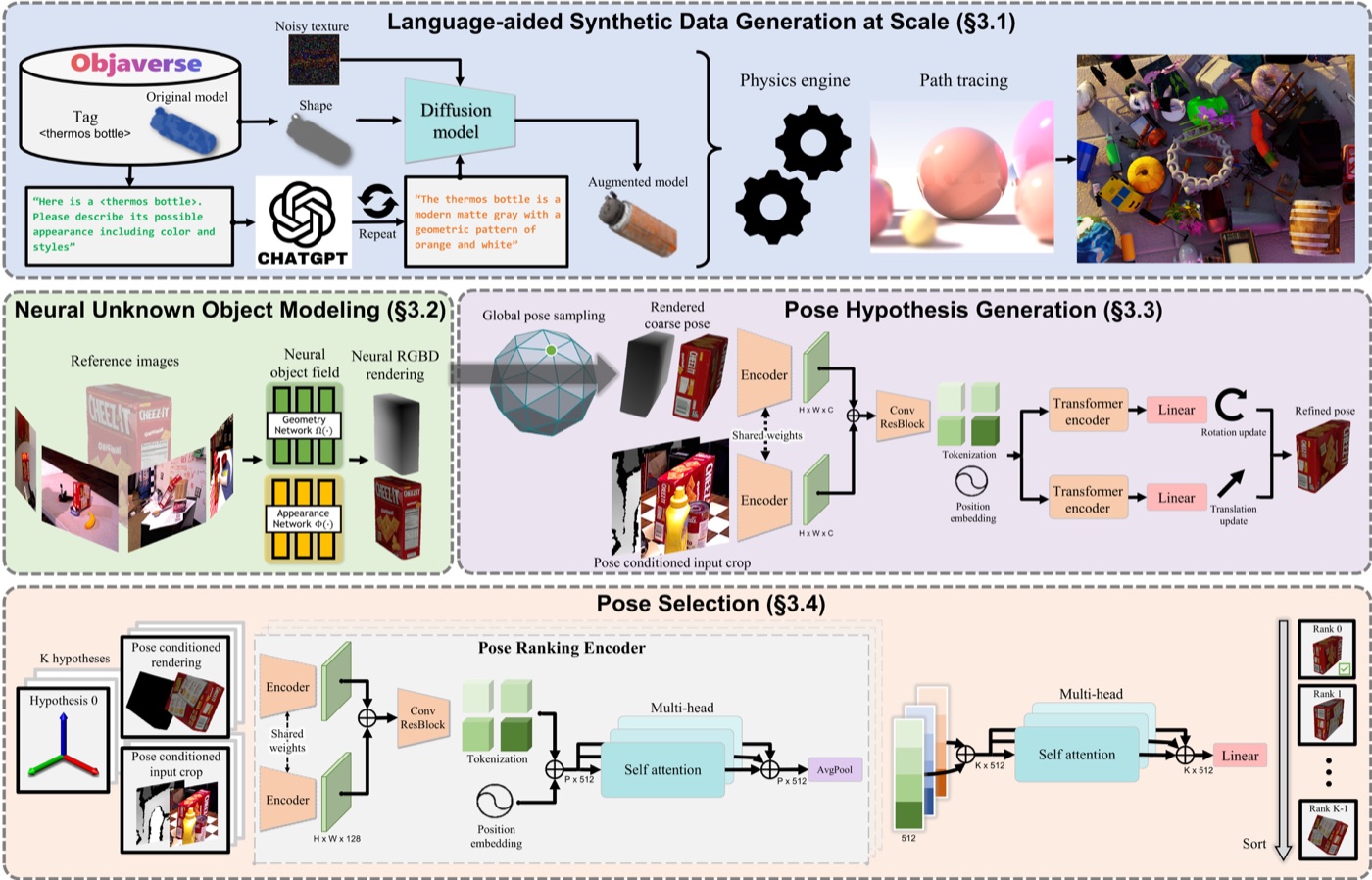 Advanced · 16 min read
What is FoundationPose?
FoundationPose solves the problem of locating a previously unseen rigid object in 3D when its shape is known. Learn how pose hypotheses are rendered, refined, ranked, and tracked, which losses train the model, and how to use it in the Telekinesis Agentic OS.
Read tutorial →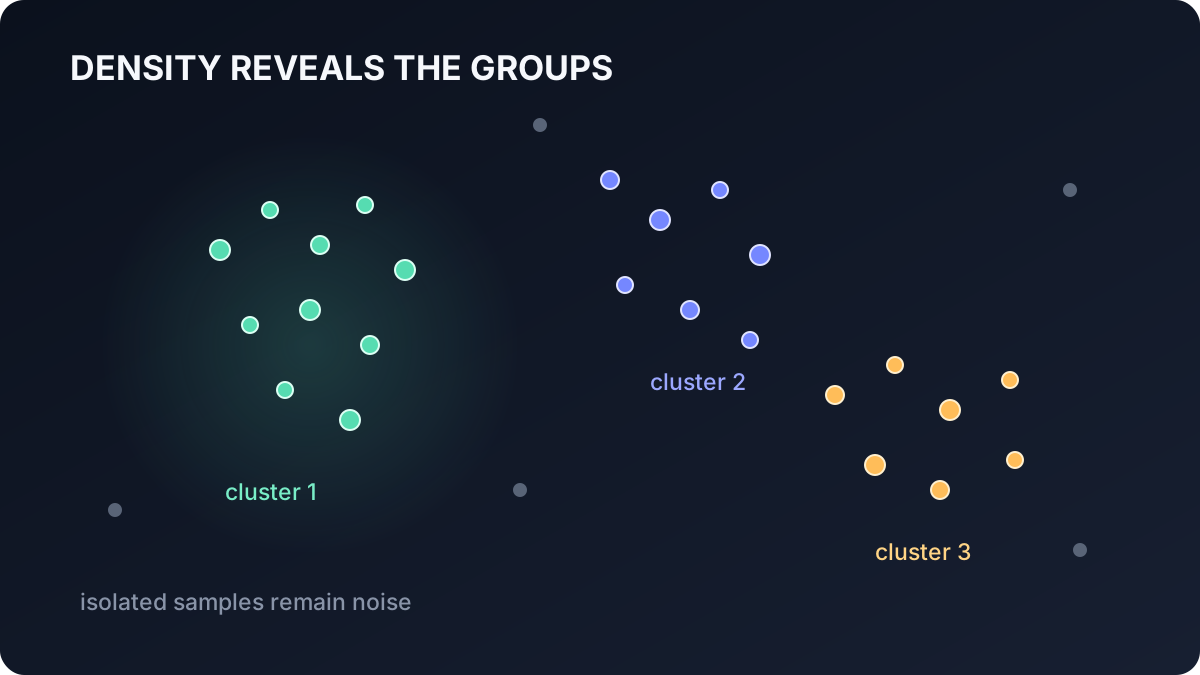 Intermediate · 10 min read
What is DBSCAN Point-Cloud Clustering?
DBSCAN separates a point cloud into dense connected groups without requiring the number of clusters in advance. Learn core, border, and noise points, density reachability, parameter tuning, computational trade-offs, and how to use DBSCAN in the Telekinesis Agentic OS.
Read tutorial →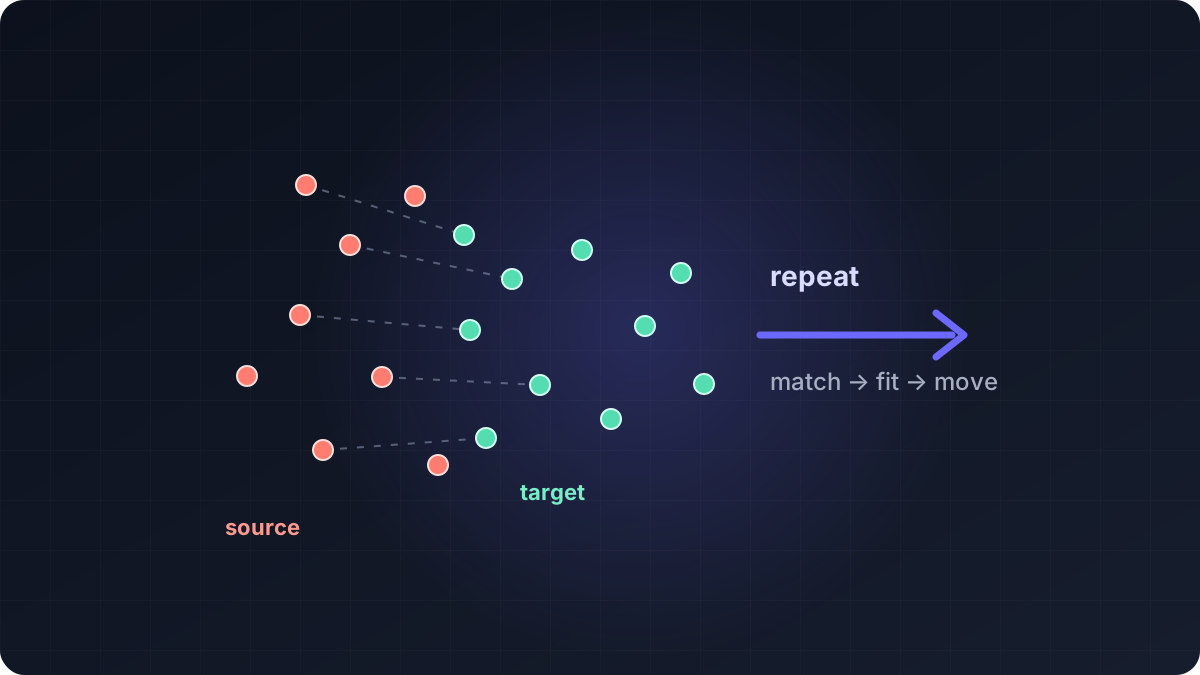 Advanced · 17 min read
What is Iterative Closest Point (ICP)?
Point-cloud registration solves the problem of placing two 3D scans in the same coordinate frame, and ICP does this by repeatedly matching nearby points and fitting a rigid transform. Learn point-to-point and point-to-plane ICP, Fast Global Registration, their mathematics and failure modes, and how to build a coarse-to-fine registration pipeline in the Telekinesis Agentic OS.
Read tutorial →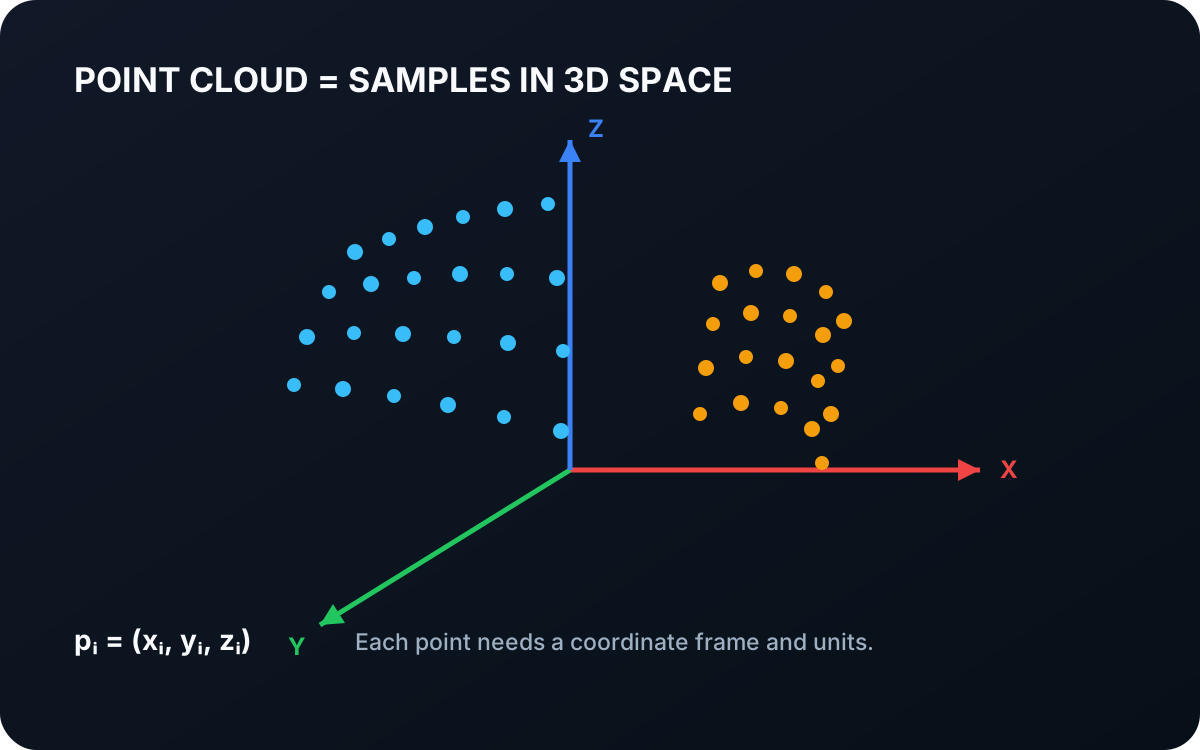 Basic · 4 min read
What is a Point Cloud?
A point cloud is a collection of sampled positions in three-dimensional space. Learn how points represent visible geometry, why coordinate frames matter, and how depth images become spatial data for robots.
Read tutorial →5. References
- Nguyen, V.-D. “Constructing Force-Closure Grasps”, The International Journal of Robotics Research, 1988.
- Telekinesis. “Generate Grasps Using Antipodal Sampler”, Vitreous Skill documentation.