A camera mounted on an industrial arm may detect a component at pixel (620, 340). The arm cannot move to a pixel. It needs the corresponding direction from the camera and the camera’s position relative to the robot. Intrinsics and extrinsics provide those two parts of the geometry.
1. What are Camera Intrinsics and Extrinsics?
Camera intrinsics describe how the camera projects 3D rays onto image pixels; camera extrinsics describe the camera’s position and orientation relative to another coordinate frame. Intrinsics explain the inside of the camera model. Extrinsics connect the camera to the outside world.
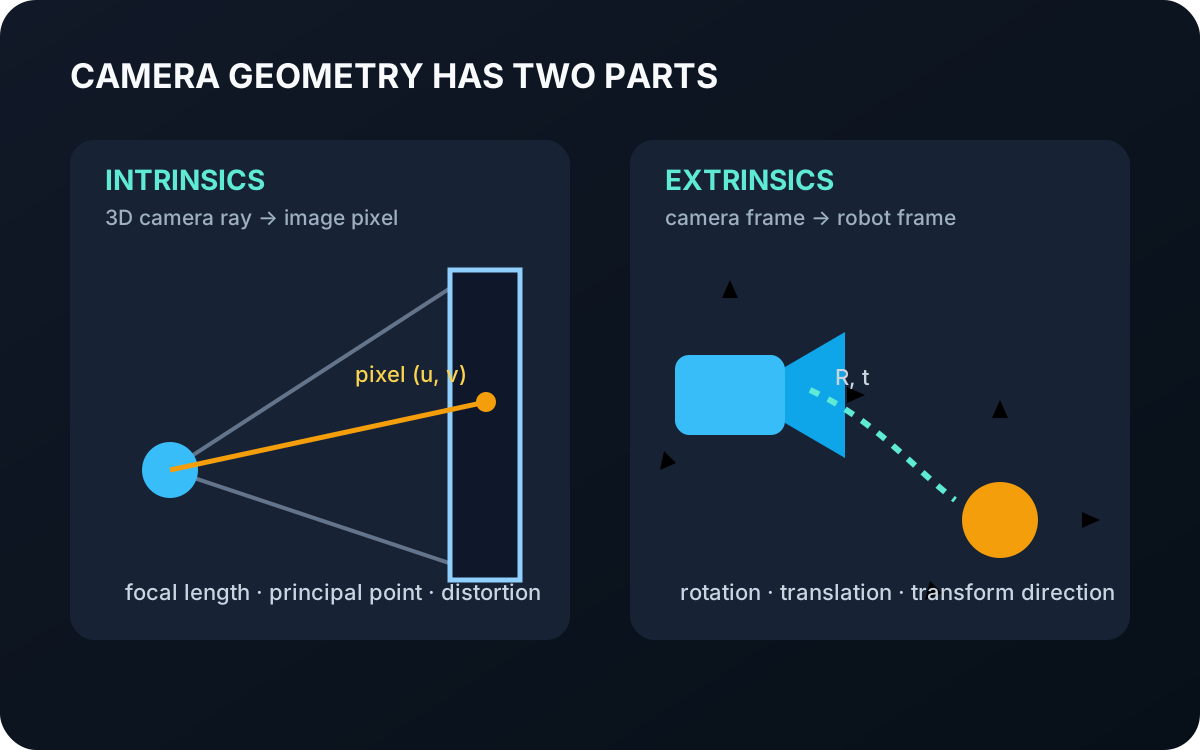
1.1 Intrinsics: From a Camera Ray to a Pixel
For a pinhole camera, the intrinsic matrix is
is the intrinsic matrix, and are focal lengths measured in pixels, and is the principal point—the image position where the optical axis meets the sensor model.
For a 3D point already expressed in the camera frame, the ideal pixel is
is the pixel coordinate. The division by creates perspective: an object appears smaller as its depth increases. Real lenses also bend rays, so calibration normally includes a distortion model and distortion coefficients.
Intrinsics belong to a specific image geometry. If an image is resized or cropped, the focal lengths and principal point must be adjusted to match.
1.2 Extrinsics: From the Camera Frame to the Robot Frame
The camera has its own axes, while an AMR, cobot, or drone has another coordinate frame. Extrinsics are the rigid transform between them:
is a point in camera frame , is the same physical point in robot frame , is the rotation from camera to robot, and is the translation between their origins.
Extrinsics answer questions such as “where is the camera mounted on the arm?” They do not describe focal length or lens distortion. If the camera moves on a wrist or drone gimbal, its transform to the world changes even though its intrinsics remain the same.
1.3 Using Both Together
Intrinsics alone turn a pixel plus depth into a point in the camera frame. Extrinsics then move that point into the robot frame. Reversing the path projects a robot-frame point into the image. This chain is what allows a detected image region to become a measured 3D target.
Calibration errors appear as physical errors. Incorrect intrinsics bend the mapping between pixels and rays; incorrect extrinsics shift or rotate the whole reconstructed scene. Validate the final camera-to-robot mapping with points spread across the actual workspace.
2. Camera Geometry in Telekinesis
Telekinesis deliberately represents the two concepts separately:
datatypes.CameraCalibrationstores one camera’s image resolution, distortion model, distortion parameters, and 3×3 intrinsic matrix.datatypes.Transform3Dstores a valid 4×4 rigid transform in and can represent camera-to-robot extrinsics.
from telekinesis import datatypes

intrinsics = datatypes.CameraCalibration(
    width=1280,
    height=720,
    distortion_model="plumb_bob",
    distortion_parameters=[-0.2, 0.1, 0.0, 0.0, 0.0],
    intrinsic_matrix=[1000, 0, 640, 0, 1000, 360, 0, 0, 1],
)

camera_to_robot = datatypes.Transform3D([
    [1, 0, 0, 0.35],
    [0, 1, 0, 0.00],
    [0, 0, 1, 0.80],
    [0, 0, 0, 1.00],
])
The variable names state the transform direction. That convention matters: camera_to_robot and robot_to_camera are inverses, not interchangeable matrices.
3. Where to Go Next
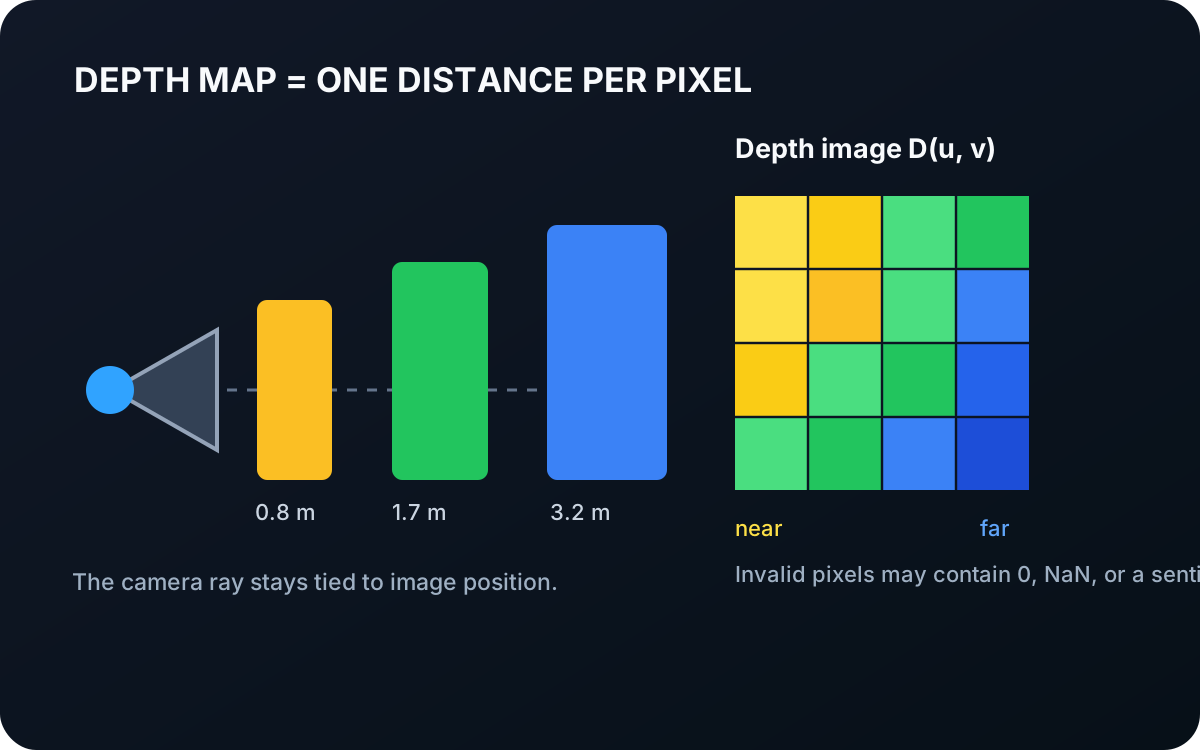 Basic · 4 min read
What is a Depth Map?
A depth map stores an estimated distance for each image position. Learn how depth remains aligned with pixels, how it differs from color, and how calibration converts it into 3D geometry.
Read tutorial →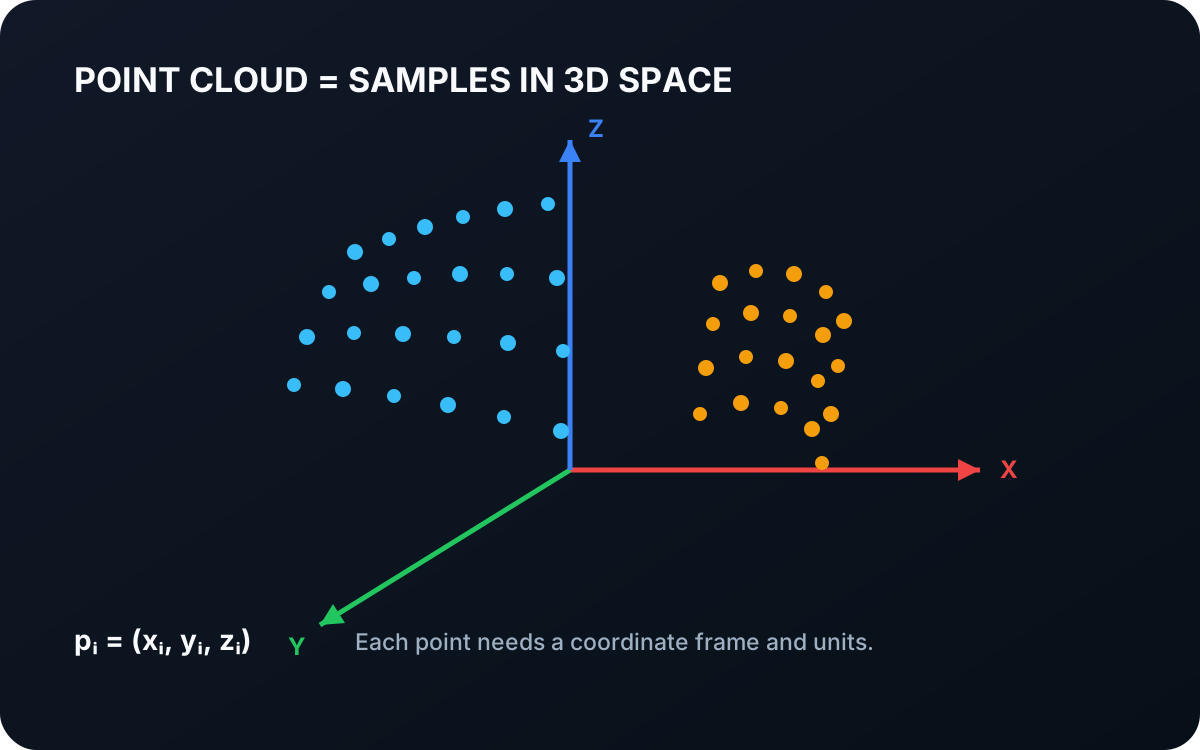 Basic · 4 min read
What is a Point Cloud?
A point cloud is a collection of sampled positions in three-dimensional space. Learn how points represent visible geometry, why coordinate frames matter, and how depth images become spatial data for robots.
Read tutorial →